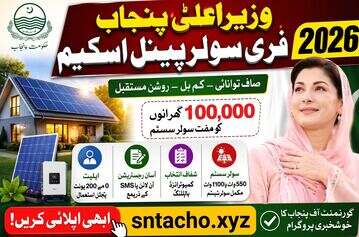
The Free Solar Panel Scheme introduced by the Government of Punjab has attracted significant attention from households looking for ways to reduce their electricity expenses and move toward renewable energy. The initiative was designed to provide solar systems to eligible domestic electricity consumers in Punjab, particularly households with relatively low electricity consumption.
For many families, the idea of receiving a solar system without paying the full market price is appealing. At the same time, there has been considerable confusion online about eligibility, registration, balloting, application status, solar system specifications, and whether applications are still being accepted in 2026.
This guide explains what the Free Solar Panel Scheme is, how the original program was structured, who was eligible, how applicants were selected, what happened after registration, and what applicants should know about the scheme’s current status.
According to the Punjab Energy Department, the original scheme had a financial outlay of Rs. 9.97 billion and targeted up to 100,000 beneficiaries. It was designed for domestic electricity consumers using up to 200 units, with a sanctioned load of up to 2 KW. Registration was conducted through the designated portal and SMS service, while computerized balloting and physical verification were part of the selection process.
However, readers should be careful when seeing websites or social media posts claiming that a new registration process is currently open. The official scheme portal currently states that registrations are closed.
This article is intended to provide a clear and practical explanation so that applicants can distinguish official information from outdated or misleading claims.
What Is the CM Punjab Free Solar Panel Scheme?
The Free Solar Panel Scheme is a Government of Punjab initiative aimed at helping eligible households adopt solar energy.
The program was introduced to support households with lower electricity consumption and encourage the use of renewable energy. Under the official scheme information, up to 100,000 solar systems were planned for eligible domestic consumers. The program specifically focused on households whose monthly electricity consumption fell within the defined limit.
The initiative is part of Punjab’s broader interest in renewable energy and energy-related support programs. The Punjab Energy Department lists renewable-energy initiatives among its major areas of work and identifies the Free Solar Panel Scheme as one of its initiatives.
The basic idea behind the scheme was straightforward. Instead of requiring eligible low-consumption households to purchase a complete solar system from the private market, qualifying beneficiaries could receive a solar system through the government-supported program.
This could help households reduce their dependence on conventional grid electricity. In addition, solar energy can provide a cleaner source of electricity when the system is properly installed and maintained.
However, receiving a solar system was not presented as an automatic benefit for every Punjab resident. Applicants had to meet the program’s eligibility requirements and go through the prescribed selection and verification process.
That distinction is important because simply submitting an application does not mean that an applicant is guaranteed to receive a solar system.
How Did the Free Solar Panel Scheme Work?
The original Free Solar Panel Scheme followed a structured selection process.
According to the Punjab Energy Department, eligible consumers could register through the designated registration system. After registration, applicants were subjected to a computerized balloting process. Physical verification was also included in the program.
The process can generally be understood through the following stages:
- Eligibility was considered based on the scheme’s criteria.
- Applicant and electricity-consumer information was submitted.
- Applications were processed through the designated system.
- Eligible applications were included in the computerized balloting process.
- Selected applicants were subject to verification.
- Successful beneficiaries could then proceed through the government’s distribution and installation process.
The purpose of using computerized balloting was to make the selection process more transparent rather than allowing every eligible applicant to receive a system automatically.
Physical verification was another important part of the program. According to the Energy Department, district administration was involved in physical verification.
Therefore, applicants needed to understand that registration was only one part of the process.
Who Was Eligible for the Free Solar Panel Scheme?
Eligibility is one of the most important questions surrounding the Free Solar Panel Scheme.
The official Punjab Energy Department information states that the original scheme was intended for domestic consumers with electricity consumption of up to 200 units and a sanctioned load of up to 2 KW. The scheme’s eligibility was linked to electricity consumption recorded in June 2024 billing.
This means that the scheme was not designed as a general solar giveaway for every household in Punjab.
Punjab Residency
The initiative was intended for eligible domestic electricity consumers in Punjab. Applicants therefore needed to fall within the geographic and consumer requirements established by the government.
Electricity Consumption
Electricity consumption was a key factor.
The official scheme description identifies domestic consumers using up to 200 units as the target group.
This condition is particularly important because many online articles and social media posts discuss the scheme without clearly explaining the consumption requirement.
Sanctioned Load
The official Energy Department also specifies a sanctioned load of up to 2 KW for the original scheme.
Applicants should therefore avoid relying on generic statements such as “everyone can apply.” Eligibility depended on specific electricity-consumer conditions.
Verification
Meeting the initial criteria did not necessarily mean that an applicant would automatically receive a system.
The program included computerized balloting and physical verification. Consequently, applicants were expected to provide accurate information and cooperate with the verification process.
Free Solar Panel Scheme Registration
Registration was an important stage of the original program.
The Punjab Energy Department states that registration was available through the designated portal and the 8800 SMS service.
However, anyone searching for Free Solar Panel Scheme registration 2026 should pay particular attention to the current status.
The official scheme portal currently displays a message stating that registrations for the CM Solar Scheme are closed.
Therefore, an old registration method should not be presented as a currently open 2026 application window.
This distinction matters because government schemes can have specific application periods. A process that was available during the original registration period may no longer accept new applications.
Applicants should always check the latest information through official Punjab government channels before submitting CNIC information or making any payment.
What Applicants Should Do Before Registering
Before using any website or application form, check:
- Whether the website belongs to an official government department.
- Whether the registration window is currently open.
- Whether the eligibility requirements have changed.
- Whether the registration process is free.
- Whether the government has announced a new phase.
- Whether the information is published by an official Punjab government source.
If a website asks for money to “guarantee” selection, applicants should be extremely cautious.
What Information Was Required?
The exact information required can depend on the official application process. However, the original scheme was based on electricity-consumer information and applicant verification.
Applicants should expect government programs of this nature to require accurate identification and electricity-related information.
Commonly relevant information may include:
- CNIC details
- Electricity consumer information
- Mobile phone number
- Residential information
- Electricity bill details
- Other information required during verification
It is important not to assume that every document listed on an unofficial website is actually required by the government.
Instead, applicants should follow the requirements shown on the official registration platform or announced by the relevant government department.
This approach can also help protect applicants from unnecessary data collection.
How Were Applicants Selected?
One of the most important features of the original Free Solar Panel Scheme was computerized balloting.
The Punjab Energy Department specifically states that transparent computerized balloting was part of the scheme.
This means that meeting the eligibility criteria did not necessarily guarantee selection.
A simplified explanation of the process is:
Eligibility → Registration → Balloting → Verification → Beneficiary Selection
The use of balloting was intended to provide a transparent mechanism when the number of eligible applicants could exceed the number of available solar systems.
The original program targeted up to 100,000 beneficiaries.
Consequently, people should be cautious about anyone claiming that they can guarantee selection in exchange for a fee.
No private individual should be able to guarantee a government balloting result.
How to Check the Free Solar Panel Scheme Result
The official scheme website has included a ballot-result page where applicants could check results using the relevant reference information and captcha.
However, the current portal status should be considered when checking information in 2026.
If an applicant already registered during the official registration period, checking the status through the official scheme platform is safer than relying on a third-party website.
Applicants should avoid entering their CNIC number into unfamiliar websites simply because those websites use words such as “CM Punjab Solar Scheme” or “Free Solar Panel Scheme.”
A genuine-looking website is not necessarily an official government website.
What Solar System Was Provided?
Many people search specifically for the size and specifications of the solar system provided under the scheme.
This is an area where online information can easily become confusing.
The government may define the equipment package, capacity, battery arrangement, inverter type, and other technical specifications for a particular phase. Those details should therefore be confirmed through the official documentation for that phase.
The Punjab Energy Department’s official scheme page confirms the existence of the Free Solar Panel Scheme and its target beneficiaries, but readers should not assume that specifications mentioned by unrelated websites automatically apply to every phase or future program.
This is particularly important in 2026 because a new solar initiative, if introduced, may have different specifications from the original program.
For this reason, applicants should verify:
- Solar panel capacity
- Number of panels
- Battery inclusion
- Inverter specifications
- Installation arrangements
- Warranty information
- Maintenance responsibilities
- Any future replacement costs
Official documentation should always be treated as the primary source for technical specifications.
Benefits of the Free Solar Panel Scheme
The Free Solar Panel Scheme was designed to provide several potential benefits to eligible households.
Lower Dependence on Grid Electricity
Solar generation can reduce the amount of electricity a household needs to obtain from the grid, depending on the system capacity and household consumption.
Potential Reduction in Electricity Costs
A properly functioning solar system can reduce grid electricity usage. The actual financial benefit, however, depends on electricity consumption, solar generation, household usage patterns, and system performance.
Therefore, claims that every beneficiary will receive a specific guaranteed reduction in their electricity bill should not be treated as reliable unless they are officially supported.
Renewable Energy
Solar power is a renewable energy source. Its use can contribute to a broader transition toward cleaner energy.
Long-Term Household Support
For households that meet the eligibility requirements, a government-supported solar system may provide a useful long-term energy resource.
Greater Awareness of Solar Energy
Programs such as this can also encourage households to learn more about renewable energy and energy efficiency.
What Happens After Selection?
Being selected is not necessarily the end of the process.
Government-supported programs generally require verification and administrative steps before a benefit is delivered.
The original scheme specifically included physical verification by district administration.
A selected applicant may therefore need to provide or confirm information before installation or delivery arrangements are finalized.
Applicants should keep their:
- CNIC information
- Electricity bill
- Application or reference information
- Mobile number
- Selection information
available for verification.
If a representative visits a household for verification, applicants should also remain cautious. Official identification and the purpose of the visit should be confirmed where appropriate.
Most importantly, applicants should not hand over cash simply because someone claims to be an “official solar scheme agent.”
Why Can an Application Be Rejected?
There can be several reasons why an application may not proceed.
For example, an applicant may not meet the defined eligibility conditions. The electricity-consumer information may also fail to match the required criteria.
Other possible issues can include:
- Incorrect information
- Incomplete information
- Ineligible electricity consumption
- Incorrect consumer details
- Verification problems
- Duplicate or inconsistent information
- Failure to satisfy the scheme’s conditions
The exact reason for rejection depends on the program rules and the applicant’s circumstances.
Applicants should therefore avoid assuming that every rejected application was rejected because of a technical problem.
If an official complaint or support mechanism is available, it should be used to obtain clarification.
Common Mistakes Applicants Should Avoid
People sometimes lose opportunities or expose themselves to unnecessary risk because they rush through registration.
Here are some common mistakes worth avoiding.
1. Using an Unofficial Website
Do not assume a website is official just because its name contains “Punjab,” “CM,” “Solar,” or “Government.”
Always check the domain and verify the information through a recognized Punjab government source.
2. Paying an Unofficial Agent
A person may claim that a payment is required to secure a place in the scheme.
Applicants should not pay unofficial individuals for guaranteed selection.
3. Sharing Sensitive Information
CNIC information, passwords, OTPs, and other personal information should not be shared with unknown people.
4. Trusting Social Media Posts Without Verification
Facebook posts, WhatsApp messages, TikTok videos, and YouTube videos may contain outdated information.
Social media can be useful for discovering news, but official government websites should be used for confirmation.
5. Assuming Registration Guarantees a Solar System
The original scheme included computerized balloting.
Therefore, registration should not automatically be interpreted as guaranteed selection.
6. Ignoring the Current Status
This is particularly important in 2026.
The official scheme portal currently says that registrations are closed.
Therefore, people should be careful with websites claiming that the same registration process is currently open without providing a verifiable official announcement.
Is the Free Solar Panel Scheme Really Free?
The term “free” refers to the government-supported provision of solar systems to eligible beneficiaries under the scheme.
The official Punjab government page describes the initiative as providing solar systems free of cost to eligible households within the program’s criteria.
However, applicants should understand the difference between an official government benefit and unofficial services.
If someone asks for a payment to register, guarantee selection, speed up balloting, or ensure installation, applicants should verify the demand through official channels before paying anything.
A government scheme should not be confused with private companies selling solar systems.
Private solar companies may offer paid installations, financing, warranties, or maintenance packages. Those are separate commercial services.
Similarly, future government solar programs may have different rules and financial arrangements.
For this reason, the exact meaning of “free” should always be checked against the official terms of the particular scheme or phase.
Free Solar Panel Scheme Scams and Fake Websites
The popularity of government assistance programs can create opportunities for scammers.
Solar schemes are especially attractive to scammers because applicants are often actively searching for registration links, eligibility information, and result-checking pages.
A fake website may copy government colors, logos, wording, or page layouts.
Some fake pages may ask visitors to:
- Enter their CNIC number
- Enter a mobile number
- Upload documents
- Pay a registration fee
- Share an OTP
- Contact an unofficial WhatsApp number
- Pay money for “confirmation”
Applicants should treat such requests carefully.
The official scheme portal currently states that registrations are closed.
Therefore, any website claiming that it has a secret or exclusive registration channel should be treated with suspicion unless the claim can be confirmed through an official government source.
How to Protect Yourself
Use these simple precautions:
Check the website domain:
Do not rely only on the design of a website.
Look for an official announcement:
Verify major claims through Punjab government departments.
Do not pay for guaranteed selection:
Balloting-based programs cannot reasonably be guaranteed by private agents.
Protect your OTP:
Never provide a verification code to an unknown person.
Do not submit documents unnecessarily:
Only provide information through a legitimate and verified government process.
Keep screenshots of genuine applications:
If you successfully submit an application through an official portal, keeping the reference information can be useful.
What Is the Current Status of the Scheme in 2026?
This is perhaps the most important update for people searching for the Free Solar Panel Scheme 2026.
The official Punjab Energy Department describes the original Free Solar Panel Scheme as a program for domestic consumers using up to 200 units, with up to 100,000 beneficiaries. Its listed completion timeline was September 30, 2025.
In addition, the official scheme portal currently displays the message that registrations are closed.
Therefore, readers should not assume that the original registration process is still accepting new applications in August 2026.
At the same time, Punjab continues to list renewable-energy initiatives and other energy projects. The Punjab Energy Department’s current website identifies renewable energy as an area of focus.
This means that readers interested in future solar initiatives should monitor official Punjab government announcements rather than relying on websites that publish unverified “new registration” claims.
It is also worth remembering that a future phase or a different solar program could have completely different eligibility rules, application dates, equipment packages, and selection methods.
Frequently Asked Questions About the Free Solar Panel Scheme
Is the Free Solar Panel Scheme a Government of Punjab program?
Yes. The Free Solar Panel Scheme is listed by the Government of Punjab’s Energy Department, and the official Punjab government website also describes the initiative.
Who was the original scheme designed for?
The original program targeted domestic electricity consumers using up to 200 units, with a sanctioned load of up to 2 KW. The official information also identifies June 2024 billing as the relevant consumption reference.
Is registration currently open in 2026?
The official scheme portal currently states that registrations are closed.
Therefore, applicants should not rely on third-party websites claiming that the original registration process is currently open.
How many beneficiaries were targeted?
The original scheme targeted up to 100,000 beneficiaries.
Was selection done through balloting?
Yes. The Punjab Energy Department identifies transparent computerized balloting as part of the scheme.
Was physical verification part of the scheme?
Yes. Physical verification by district administration was included in the official scheme description.
Was the solar system provided free of cost?
The Punjab government describes the initiative as providing solar systems free of cost to eligible households under the scheme.
However, applicants should still verify the terms of any particular phase or future program.
Can someone guarantee my selection?
Applicants should be very cautious about anyone making such a promise.
The original scheme used computerized balloting, so private individuals should not be trusted when they claim they can guarantee selection in exchange for money.
Should I pay an agent for registration?
Applicants should verify whether any payment is officially required before paying anyone.
In particular, a person demanding money in exchange for guaranteed selection should be treated with suspicion.
Can I trust every website offering solar scheme registration?
No.
Applicants should verify websites through official Punjab government sources before entering personal information.
What should I do if I receive a suspicious solar scheme message?
Do not immediately click the link or provide your CNIC, password, OTP, or payment information.
Instead, verify the claim through an official Punjab government website or department.
Where can I find reliable information?
The Punjab Energy Department is one of the key official sources for information about the scheme. Its website lists the Free Solar Panel Scheme among its initiatives.
Final Thoughts
The Free Solar Panel Scheme was an important renewable-energy initiative designed to support eligible low-consumption households in Punjab. The original program targeted up to 100,000 beneficiaries and included eligibility screening, computerized balloting, and physical verification.
For people searching for the scheme in 2026, however, the current status is more important than old registration instructions. The official scheme portal currently says that registrations are closed, while the Punjab Energy Department’s published information gives the original program a completion timeline of September 30, 2025.
Therefore, applicants should be careful with outdated articles, social media posts, and websites claiming to offer a new registration facility.
If Punjab announces a new phase or a separate solar initiative, the eligibility criteria, registration procedure, system specifications, and application dates should be checked from the official announcement before any application is submitted.
Most importantly, never pay an unofficial person for guaranteed selection, and never share sensitive personal information with an unverified website or individual.
Solar energy can provide meaningful benefits for households, but reliable information is just as important as the technology itself. By checking official sources and avoiding unverified claims, applicants can make better decisions and reduce the risk of scams.
Disclaimer
Asanjani24 is not an official website of the Government of Punjab, any Punjab government department, or any other government authority. We are an independent informational website and are not affiliated with, endorsed by, or officially connected to the Government of Punjab or the CM Punjab Free Solar Panel Scheme.
The information published in this article is provided for general informational and educational purposes only. Government schemes, eligibility requirements, registration procedures, deadlines, and policies may change over time. Although reasonable efforts are made to provide useful and accurate information, readers should verify important details through the relevant official government sources before taking any action.
We do not guarantee eligibility, selection, approval, installation, financial benefits, or participation in any government scheme. We also do not collect or process applications on behalf of the Government of Punjab. Readers should use official government channels for applications, verification, complaints, and the latest announcements.